Highlights
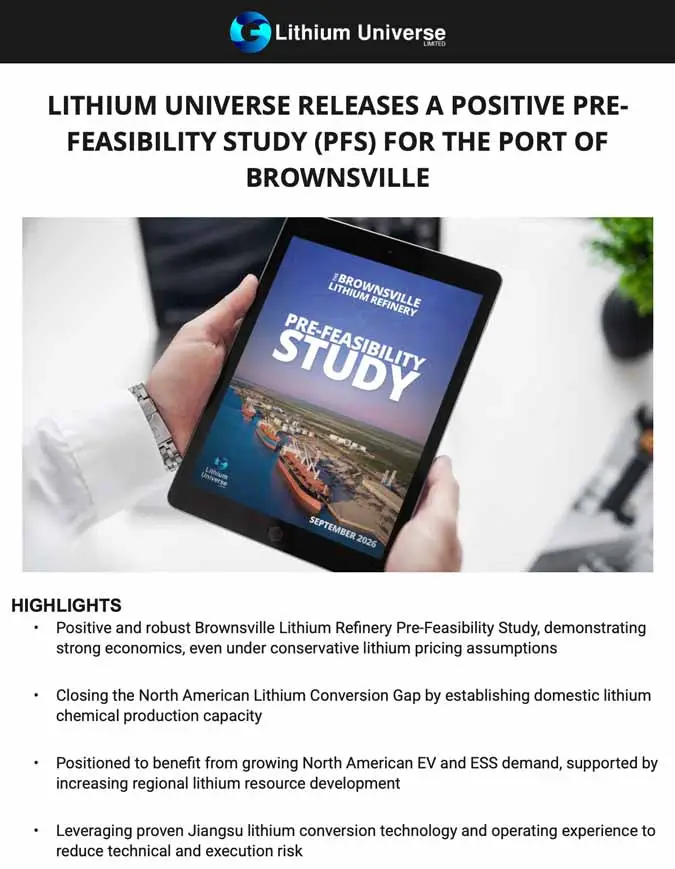
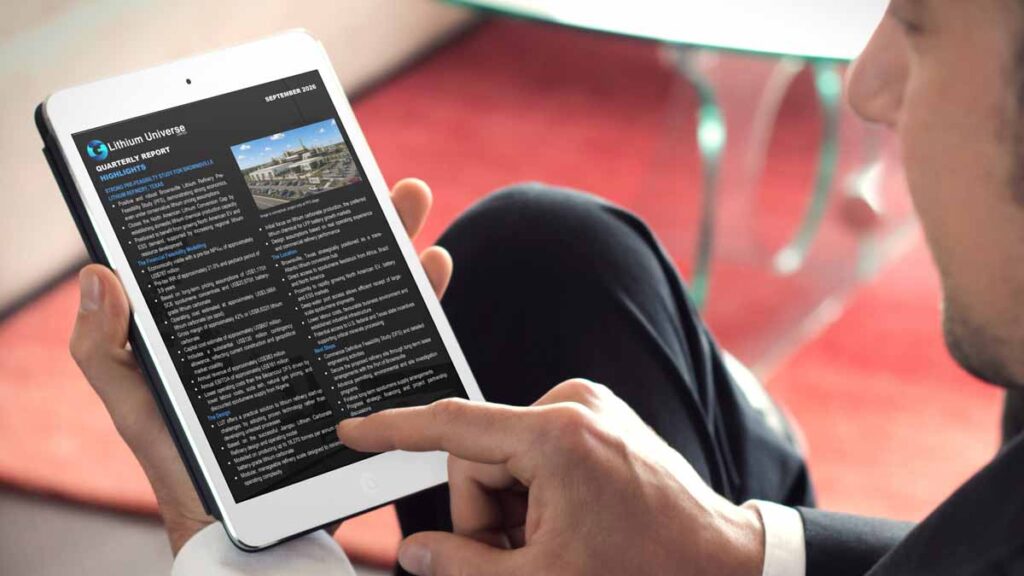
STRONG PRE-FEASIBILITY STUDY FOR BROWNSVILLE LITHIUM REFINERY, TEXAS
• Positive and robust Brownsville Lithium Refinery Pre-Feasibility Study (PFS), demonstrating strong economics, even under conservative lithium pricing assumptions
• Closes the North American Lithium Conversion Gap by establishing domestic lithium chemical production capacity
• Positioned to benefit from growing North American EV and ESS demand, supported by increasing regional lithium resource development
The Financial Feasibility Modelling
• Economically viable with a pre-tax NPV8% of approximately US$787 million
• Pre-tax IRR of approximately 21.0% and payback period of 3.9 years
• Based on long-term pricing assumptions of US$1,170/t SC6 spodumene concentrate and US$20,970/t batterygrade lithium carbonate
• Operating cost estimated at approximately US$3,566/t lithium carbonate (ex spod)
• Gross margin of approximately 42% or US$8,822/t lithium carbonate
• Capital cost estimate of approximately US$607 million
• Includes a substantial US$130 million contingency allowance, reflecting current construction and geopolitical
market volatility
• Annual revenue of approximately US$383 million
• Annual EBITDA of approximately US$161 million
• Lower operating costs than the Bécancour DFS driven by lower labour costs, soda ash, natural gas pricing, and
discounted spodumene supply from Nigeria
The Design
• LU7 offers a practical solution to lithium refinery start-up challenges by adopting proven technology rather than
developing untested processes
• Based on the successful Jiangsu Lithium Carbonate Refinery design and operating model
• Modelled on producing up to 18,270 tonnes per annum of battery-grade lithium carbonate
• Modular, manageable refinery scale designed to minimise operating complexity
Image is conceptual, project only at PFS stage
• Initial focus on lithium carbonate production, the preferred lithium chemical for LFP battery growth markets
• Design assumptions based on real operating experience and commercial refinery performance
The Location
• Brownsville, Texas, strategically positioned as a trans-Atlantic lithium conversion hub
• Direct access to spodumene feedstock from Africa, Brazil and North America
• Proximity to rapidly growing North American EV, battery and ESS markets
• Deep-water port access allows efficient receipt of large-scale spodumene shipments
• Lower labour costs, favourable business environment and established industrial infrastructure
• Potential access to U.S. federal and Texas state incentives supporting critical minerals processing
Next Steps
• Commence Definitive Feasibility Study (DFS) and detailed engineering activities
• Secure the proposed refinery site through long-term lease arrangements with the Port of Brownsville
• Advance permitting, environmental and site investigation programs
• Finalise long-term spodumene supply arrangements
• Progress strategic financing and project partnership discussions
LU7 SUCCESSFULLY RECOVERS CRITICAL METALS GALLIUM AND PLATINUM FROM E-WASTE
• In addition to recoverable gold and copper from electronic circuit boards, Edinburgh University test work successfully targets gallium and platinum recovery
• Diamide ligand successfully extracts and precipitates gallium
• Gallium recovery exceeds 99% under laboratory conditions
• Diamide ligand successfully precipitates platinum
• Process conditions can target different critical metals
• Recyclable ligand offers potential for sequential metal recovery
• Gallium is critical to semiconductors and advanced electronics
• Gallium global market of US$1 billion annually
• Electronic chips contain approximately 0.9–1.3 mg of gallium
• E-waste fractions can contain up to 35% gallium and valued at approximately US$237/kg
• Platinum recovery reaches approximately 99-100% under laboratory conditions • Platinum is a high-value critical metal with a global market worth US$9 billion annually
• Mobile-phone circuit boards contain approximately 14 g/t of platinum
• Some circuit boards contain up to 40 g/t platinum and are valued at approximately US$1,780/oz
MACQUARIE CSIRO COLLABORATION
• Joint LU7-Macquarie University-CSIRO research project announced to advance LU7’s solar-panel recycling
technology
• Microwave delamination separates panels without crushing or contamination
• Enables higher-quality recovery of silicon, glass, silver and other metals
• CSIRO and Macquarie University provide specialist expertise and facilities
• Independent CSIRO involvement strengthens LU7’s scientific credibility
• Reduces LU7’s research and technology-development costs
• In addition to recoverable gold and copper from electronic circuit boards, Edinburgh University test work successfully targets gallium and platinum recovery